
Key Takeaway
For Hillsboro homes, tankless water heaters provide unlimited hot water and lower operating costs but require higher upfront investment. Tank water heaters cost less initially and work well for smaller households. The right choice depends on your household size, budget timeline, and how long you plan to stay in the home.
When your water heater fails, or when you are building, remodeling, or simply upgrading, you face a fundamental choice: replace with another standard tank water heater or switch to a tankless (on-demand) system. Both technologies work. Both have legitimate advantages. The right choice depends on your household size, hot water usage patterns, existing infrastructure, budget priorities, and how long you plan to stay in your home.
This guide breaks down both options with specific considerations for Hillsboro and Portland metro area homes so you can make an informed decision.
How Tank Water Heaters Work
A tank water heater stores a fixed volume of hot water, typically 40 to 50 gallons for residential use, in an insulated tank. A gas burner or electric heating element keeps the stored water at your set temperature (usually 120 degrees Fahrenheit) at all times, whether you are using hot water or not. When you open a hot water faucet, hot water flows from the top of the tank while cold water enters at the bottom to be heated.
The tank refills and reheats continuously. This means hot water is available immediately when you turn on a faucet, but the supply is limited to what the tank holds. Once you deplete the stored hot water by running multiple showers, filling a bathtub, and running the dishwasher simultaneously, you must wait for the tank to reheat before hot water is available again. This recovery time is typically 30 to 60 minutes for gas models and 60 to 90 minutes for electric models.
Tank Water Heater Advantages
Lower upfront cost. Tank water heaters cost significantly less to purchase and install than tankless systems. A standard 50-gallon gas tank water heater including professional installation typically costs 40 to 60 percent less than a comparable tankless installation.
Simpler installation. Replacing a tank water heater with another tank of the same fuel type is straightforward. The existing gas line, venting, and water connections are already sized correctly. Installation takes 3 to 5 hours with no modifications to your home's infrastructure.
Proven reliability. Tank water heaters have been the standard for over a century. The technology is simple, parts are universally available, and any plumber can service them. When they do need repair, parts are inexpensive and readily available.
No minimum flow rate. Tank water heaters deliver hot water regardless of flow rate. You can run a trickle at a single faucet and get hot water. Tankless units require a minimum flow rate to activate, which can be an issue with low-flow fixtures.
Tank Water Heater Disadvantages
Limited hot water supply. Once the tank is depleted, you wait for recovery. Large households that run multiple hot water fixtures simultaneously can exhaust a standard tank.
Standby heat loss. The tank maintains water temperature 24 hours a day whether you use hot water or not. This standby energy consumption adds to your monthly utility bill. Typically 20 to 30 percent of the energy used goes to maintaining temperature in the tank during periods of no use.
Shorter lifespan. Tank water heaters typically last 8 to 12 years. The tank itself eventually corrodes from the inside despite the sacrificial anode rod designed to slow this process. Once the tank lining fails, the unit must be replaced.
Physical size. A 50-gallon tank water heater is a large appliance, approximately 5 feet tall and 2 feet in diameter. It requires dedicated floor space in a utility closet, garage, or basement.
How Tankless Water Heaters Work
A tankless water heater does not store hot water. Instead, it heats water on demand as it flows through the unit. When you open a hot water faucet, a flow sensor detects water movement and activates a gas burner or electric heating element. Water passes through a heat exchanger and exits the unit at your set temperature. When you close the faucet, the unit shuts off.
Because there is no tank to deplete, a tankless water heater provides continuous hot water indefinitely, so you will never run out during a long shower or while filling a large bathtub. However, the unit has a maximum flow rate it can heat at one time. If you exceed that capacity by running too many fixtures simultaneously, the output temperature drops.
Tankless Water Heater Advantages
Unlimited hot water. A properly sized tankless unit provides continuous hot water for as long as you need it. No recovery time, no running out mid-shower.
Lower operating costs. Because tankless units only heat water when you use it, they eliminate standby heat loss entirely. Monthly energy savings typically range from 20 to 35 percent compared to a tank water heater, depending on your usage patterns.
Longer lifespan. Tankless water heaters typically last 15 to 20 years, roughly double the lifespan of a tank unit. Many components are individually replaceable, further extending service life.
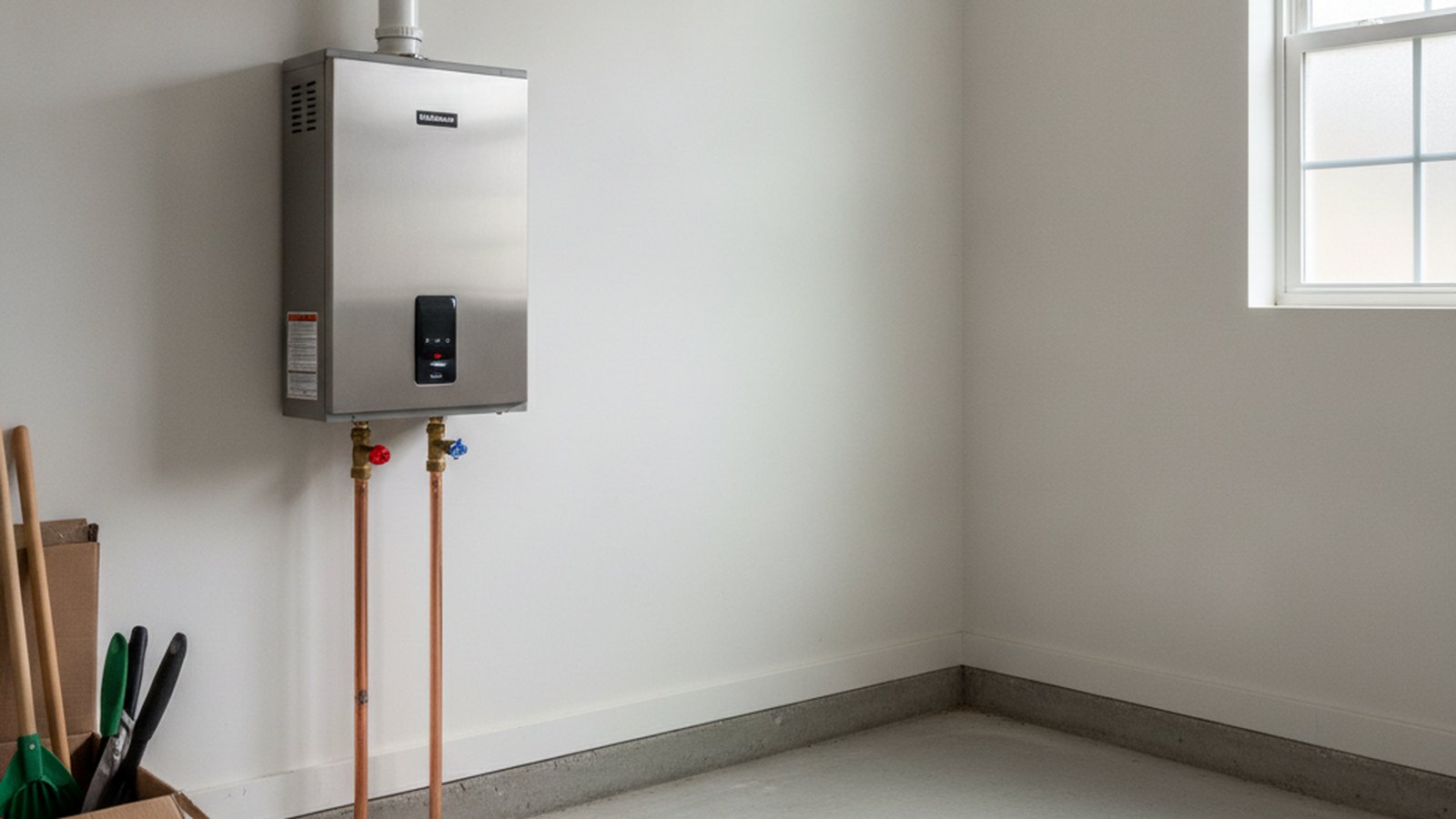
Compact size. A tankless unit mounts on a wall and is approximately the size of a carry-on suitcase. This frees up significant floor space in your utility area.
Reduced water damage risk. No tank means no risk of a 40 to 50 gallon tank failure flooding your home. Tank failures are one of the top causes of residential water damage.
Tankless Water Heater Disadvantages
Higher upfront cost. Tankless water heaters cost more to purchase, and installation is more complex, especially when converting from a tank system. Gas line upsizing, new venting, and electrical work may be required.
Cold water sandwich effect. When you turn off hot water briefly and turn it back on, you may experience a brief burst of cold water between the hot water sitting in the pipes and the newly heated water. This is a minor annoyance rather than a functional problem.
Minimum flow rate required. Tankless units need a minimum water flow to activate the burner. Very low-flow fixtures or barely-open faucets may not trigger heating.
Simultaneous demand limitations. While a tankless unit provides unlimited duration, it has a maximum flow rate. Running three showers, a dishwasher, and a washing machine simultaneously may exceed the unit's capacity. Larger households may need a higher-capacity unit or multiple units.
More complex maintenance. Tankless units require periodic descaling (flushing with vinegar solution) to remove mineral buildup in the heat exchanger. In areas with harder water, this may be needed annually.
Factors Specific to Hillsboro and the Portland Metro Area
Cold Incoming Water Temperature
The temperature of water entering your home from the municipal supply directly affects water heater performance. In Hillsboro, incoming water temperature varies seasonally, running approximately 50 to 55 degrees Fahrenheit in summer and 38 to 45 degrees in winter. This means your water heater must raise the temperature by 65 to 82 degrees to reach a 120-degree output.
For tankless units, colder incoming water reduces the maximum flow rate the unit can handle while maintaining output temperature. A unit rated for 9 gallons per minute in a warm climate may only deliver 6 to 7 gallons per minute during a Hillsboro winter. This is critical for sizing. You need a unit rated for your winter demand, not your summer demand.
Natural Gas Availability
Most Hillsboro homes have natural gas service from NW Natural. Gas tankless water heaters are significantly more powerful than electric models and are the standard recommendation for whole-home tankless installations. If your home already has gas service, a gas tankless unit is typically the best choice. If your home is all-electric, an electric tankless unit may require a significant electrical panel upgrade (often 200-amp service) to handle the load.
Housing Stock and Installation Considerations
Homes in newer Hillsboro developments (South Hillsboro, Reed's Crossing, Orenco Station) often have modern gas lines and venting that simplify tankless installation. Older homes near downtown Hillsboro, Shute Park, and Jackson School may have smaller gas lines that need upsizing and older venting that needs replacement for a tankless conversion.
If your home currently has a gas tank water heater in the garage or utility closet, converting to tankless typically requires running a larger gas line from the meter to the new unit location and installing new category III stainless steel venting. These modifications add to the installation cost but are one-time investments that serve the unit for its entire 15 to 20 year lifespan.
Which System Fits Your Household?
Choose a Tank Water Heater If:
- Your household has 1 to 3 people with moderate hot water demand
- You want the lowest upfront cost
- Your current tank water heater location and connections are in good condition
- You plan to sell the home within the next 5 years (the payback period for tankless may not be realized)
- Your hot water usage is concentrated in short periods rather than extended simultaneous demand
Choose a Tankless Water Heater If:
- Your household has 3 or more people who frequently run out of hot water
- You want lower monthly operating costs and are willing to invest more upfront
- You plan to stay in the home long enough to realize the energy savings (typically 5 to 8 years to break even)
- You want to free up floor space currently occupied by a tank
- You want to eliminate the risk of a tank failure flooding your home
- You are already remodeling and can incorporate the installation into the project scope
The Financial Comparison
Over a 15-year period (the typical lifespan of a tankless unit), the total cost of ownership often favors tankless despite the higher upfront investment. Here is why: a tank water heater lasts 8 to 12 years, meaning you will likely need to purchase and install two tank units during the same period one tankless unit serves you. When you factor in two tank purchases plus two installations plus higher monthly energy costs over 15 years, the tankless system often costs the same or less in total, while providing superior performance throughout.
However, if your budget is constrained today and you need a water heater replaced immediately, a tank replacement gets you hot water at a lower immediate cost. There is no wrong answer, as both systems work well. The right choice depends on your priorities.
SKS Plumbing Installs Both Systems
SKS Plumbing LLC installs and services both tank and tankless water heaters in Hillsboro and surrounding areas. We do not push one system over the other. We assess your home, discuss your needs and budget, and recommend the option that makes the most sense for your specific situation. We install all major brands including Rheem, AO Smith, Bradford White, Navien, Rinnai, and Noritz.
We currently offer $200 off any new water heater installation or replacement, tank or tankless. Call (503) 319-9348 for a free in-home assessment and estimate. We are available 7 days a week from 8am to 9pm.
Frequently Asked Questions
Tankless water heaters typically last 15 to 20 years, roughly double the 8 to 12 year lifespan of a standard tank water heater. Many tankless components are individually replaceable, further extending service life.
Yes, when properly sized. A single gas tankless unit can supply most Hillsboro homes. However, during winter when incoming water is colder (38 to 45 degrees), the maximum flow rate decreases. Proper sizing accounts for winter demand, not summer.
Tankless installation costs more than tank replacement due to potential gas line upsizing, new venting, and electrical work. SKS Plumbing currently offers $200 off any new water heater installation. Call (503) 319-9348 for a free in-home assessment.
Yes. Tankless units require periodic descaling (flushing with vinegar solution) to remove mineral buildup in the heat exchanger. In the Portland metro area, this is typically needed annually to maintain efficiency and prevent damage.
If you plan to stay in your home 5+ years, have 3+ people in your household, and frequently run out of hot water, the switch typically pays for itself through energy savings and avoiding a second tank replacement. For smaller households or short-term ownership, a tank replacement is more cost-effective.