
Key Takeaway
Always get a sewer camera inspection before committing to repair or replacement. If damage is localized in otherwise sound pipe, repair makes sense. If your line is clay tile, Orangeburg, or shows widespread deterioration, full replacement eliminates the problem permanently and costs less than repeated repairs over time.
When your sewer line develops problems such as recurring backups, slow drains throughout the house, sewage odors, or wet spots in your yard, you face a decision that involves significant money either way. Do you repair the specific damaged section and hope the rest of the line holds up? Or do you replace the entire line and eliminate the problem permanently?
This is not a decision you should make based on gut feeling or a contractor's recommendation alone. It is a decision that should be driven by data. Specifically, what a sewer camera inspection reveals about the condition of your entire line, not just the section currently causing problems.
This guide walks you through the factors that determine whether repair or replacement is the right call for your situation.
Start With a Camera Inspection
Before committing to any sewer line work beyond basic drain cleaning, you need a sewer camera inspection. This involves feeding a waterproof camera through your sewer line from a cleanout access point to the city connection at the street. The camera provides real-time video of the pipe interior, revealing the exact condition, material, damage locations, root intrusion points, joint separations, bellies (low spots), and overall structural integrity.
A camera inspection costs a fraction of what either repair or replacement costs, and it provides the information needed to make an informed decision. Without it, you are guessing, and guessing wrong on sewer line work is expensive.
What the Camera Reveals
A thorough camera inspection identifies:
- Pipe material. Clay tile, cast iron, ABS, PVC, or Orangeburg (tar paper)
- Joint condition. Whether joints are intact, separated, or offset
- Root intrusion. Location and severity of root penetration
- Cracks and breaks. Longitudinal cracks, circumferential breaks, or crushed sections
- Bellies. Low spots where the pipe has settled and water pools
- Buildup. Grease, scale, or mineral deposits reducing flow
- Overall condition. Whether damage is localized or widespread
This information drives the repair-versus-replace decision. A single root intrusion point in an otherwise sound PVC line calls for a very different approach than widespread joint separation in a 60-year-old clay tile line.
When Repair Is the Right Choice
Sewer line repair, meaning fixing a specific damaged section rather than replacing the entire line, makes financial and practical sense when the following conditions are met:
The damage is localized. If the camera inspection shows one damaged section, such as a single root intrusion point, one cracked joint, or a short collapsed area, while the rest of the line is in good condition, a spot repair addresses the problem without the cost of full replacement.
The pipe material is durable. If your sewer line is ABS or PVC (plastic pipes used from the 1970s onward), the material itself has a long remaining lifespan. A localized failure in an otherwise sound plastic line is worth repairing because the rest of the system will likely serve you for decades more.
The line is relatively new. A sewer line installed 20 to 30 years ago that develops a single point of failure, perhaps from construction damage, ground settling, or an isolated root intrusion, is a good candidate for spot repair. The overall system has significant remaining life.
Access is straightforward. If the damaged section is in an accessible location, under a lawn rather than under a driveway, patio, or the house itself, the excavation and repair cost is reasonable relative to the benefit.
What Repair Involves
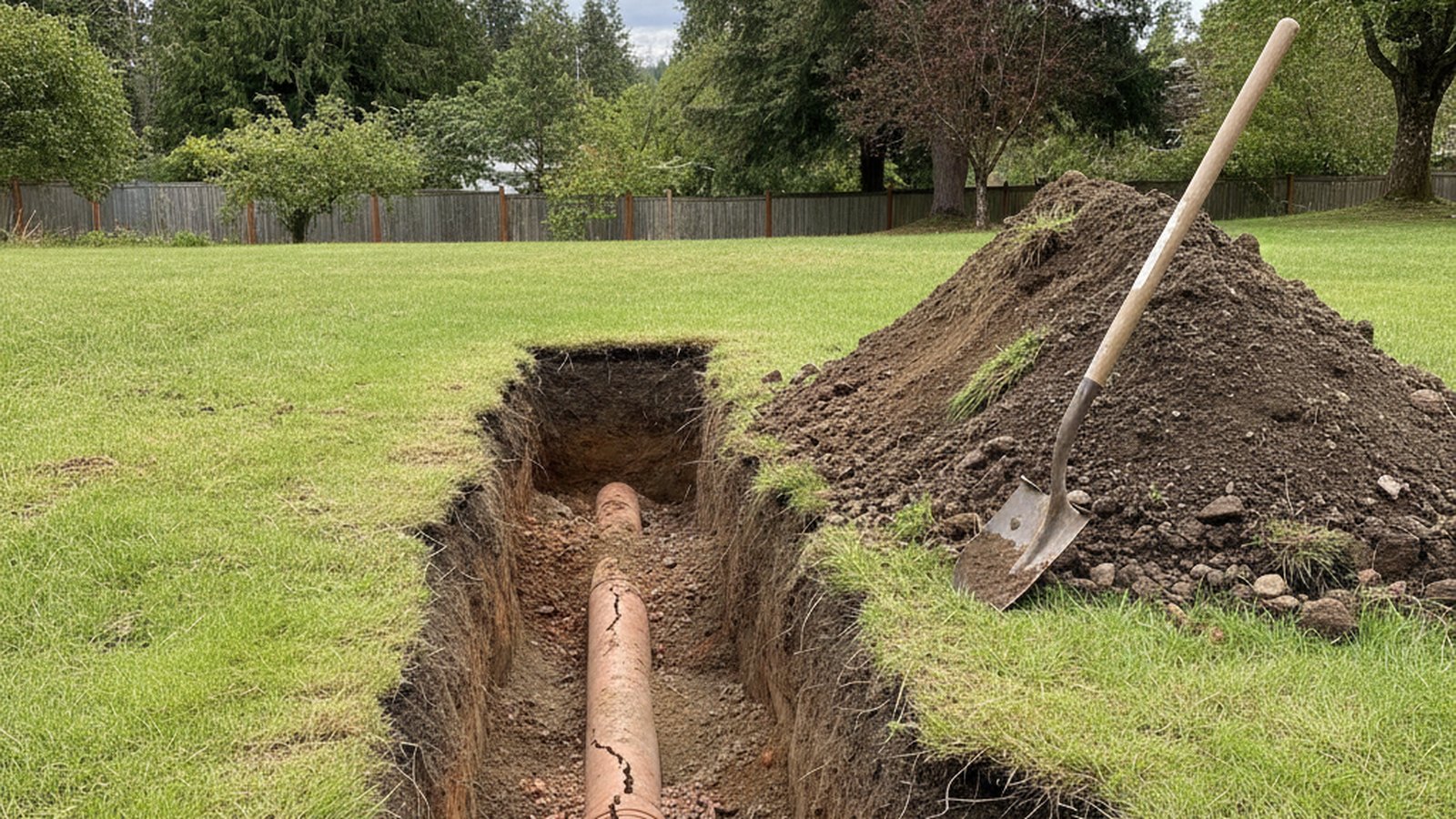
A spot repair involves excavating down to the damaged section of pipe, cutting out the failed portion, and splicing in new pipe with appropriate couplings. The excavation is backfilled, compacted, and the surface is restored. For a typical residential sewer line buried 3 to 6 feet deep, this involves a hole approximately 4 to 6 feet long and 3 to 4 feet wide. The repair itself takes a few hours once the pipe is exposed. Total project time including excavation and backfill is typically half a day to a full day.
When Replacement Is the Right Choice
Full sewer line replacement, meaning removing the entire line from house to street and installing new pipe, is the correct decision when:
The pipe material has a known failure mode. Clay tile pipes (installed before 1970) fail at joints where roots enter and where ground movement causes separation. Orangeburg pipes (tar paper, installed 1940s through 1960s) collapse under soil weight as the material deteriorates. Cast iron pipes corrode from the inside and develop widespread pitting. These materials do not have isolated failures. They deteriorate systemically, and repairing one section simply moves the next failure to a different location.
The camera shows widespread damage. If the inspection reveals root intrusion at multiple joints, several cracked sections, joint separation throughout the line, or a general condition of deterioration, spot repairs become a losing strategy. You would be paying for multiple repairs over the coming years as each section fails in sequence, ultimately spending more than a single replacement would have cost.
The line has a belly. A belly is a low spot where the pipe has settled below the proper grade. Water pools in the belly rather than flowing to the street, causing debris accumulation and recurring backups. Bellies cannot be fixed with cleaning or spot repair. The pipe must be re-laid at proper slope, which typically means replacing the affected section or the entire line.
You have already paid for multiple repairs. If you have cleared the same line multiple times in the past few years, or have already paid for one or more spot repairs, the pattern is clear: the system is failing progressively. Each additional repair is money spent on a deteriorating asset. Replacement breaks the cycle permanently.
The line is Orangeburg. Orangeburg pipe (also called bituminous fiber pipe) was made from layers of wood pulp impregnated with coal tar. It was cheap and easy to install, but it has a lifespan of only 30 to 50 years and deforms under soil pressure. If your home has Orangeburg sewer pipe, replacement is not a question of if but when. Most Orangeburg lines installed in the 1950s and 1960s have already failed or are in advanced stages of collapse.
What Replacement Involves
Full sewer line replacement involves excavating a trench from your home's foundation to the city sewer connection at the street or property line. The old pipe is removed and new pipe, typically 4-inch ABS or PVC, is installed at proper slope (typically 1/4 inch per foot of fall). Connections are made at both ends, the line is tested, and the trench is backfilled with proper bedding material and compacted in lifts. Surface restoration, whether lawn, landscaping, concrete, or asphalt, is completed as the final step.
For a typical Hillsboro home with 40 to 60 feet of sewer line buried 4 to 6 feet deep, replacement takes 1 to 3 days depending on soil conditions, depth, and surface restoration requirements.
The Financial Calculation
Here is the framework for evaluating cost:
Spot repair addresses one failure point. If the rest of the line is sound, you pay once and the problem is solved for the foreseeable future. If the rest of the line is deteriorating, you will pay for additional repairs as subsequent sections fail, potentially 2 to 4 more repairs over the next 5 to 10 years.
Full replacement costs more upfront but eliminates all future sewer line issues for 50+ years (the expected lifespan of modern ABS/PVC pipe). If you would otherwise face 3 or more spot repairs over the coming decade, replacement is typically the more economical choice when you factor in repeated excavation costs, repeated surface restoration, and the inconvenience of recurring failures.
The camera inspection provides the data needed to estimate how many future repairs the existing line is likely to need. A line with one isolated problem in otherwise good pipe favors repair. A line with multiple issues in aging material favors replacement.
Sewer Line Materials Common in Hillsboro
Understanding your pipe material helps predict its remaining lifespan and failure patterns:
Clay tile (pre-1970). Rigid pipe installed in 2 to 3 foot sections with mortar joints. Joints are the weak point. Roots enter at every joint, and ground movement causes separation. Expected lifespan: 50 to 60 years. Most clay tile lines in Hillsboro are now 55 to 75 years old.
Cast iron (1920s through 1970s). Heavy metal pipe that resists root intrusion but corrodes internally over time. Develops widespread pitting and eventually holes. Expected lifespan: 50 to 75 years.
Orangeburg (1940s through 1960s). Tar-impregnated wood fiber pipe. Deforms and collapses under soil weight. Expected lifespan: 30 to 50 years. Any remaining Orangeburg is past its useful life.
ABS (1970s onward). Black plastic pipe. Resistant to roots and corrosion. Expected lifespan: 50 to 80+ years. Failures are typically from physical damage or improper installation rather than material deterioration.
PVC (1980s onward). White or green plastic pipe. Similar performance to ABS. Expected lifespan: 50 to 100+ years. The current standard for residential sewer line installation.
Root Intrusion: The Most Common Hillsboro Sewer Problem
The Portland metro area's large deciduous trees, including maples, oaks, Douglas firs, and ornamental trees, send roots toward sewer lines seeking the moisture and nutrients inside. Roots enter through joints in clay tile pipes, through cracks in cast iron, and occasionally through poorly sealed joints in older ABS installations.
Once inside the pipe, roots grow rapidly in the nutrient-rich environment, creating a mass that catches debris and causes recurring backups. Hydro-jetting can clear root masses and restore flow, but the roots regrow, typically within 6 to 18 months depending on the tree species and proximity.
For clay tile lines with root intrusion at multiple joints, the long-term solution is replacement with modern plastic pipe that has sealed joints roots cannot penetrate. For lines with a single root entry point, spot repair at that location may be sufficient if the rest of the line is sound.
Making Your Decision
The decision framework is straightforward:
- 1Get a camera inspection to understand the full condition of your line
- 2Identify the pipe material and its expected remaining lifespan
- 3Count the number and severity of damage points
- 4Determine whether damage is localized or widespread
- 5Calculate the likely cost of continued repairs versus one-time replacement
SKS Plumbing LLC provides sewer camera inspections, drain cleaning, spot repairs, and full sewer line replacements across Hillsboro, Beaverton, Tigard, Forest Grove, and surrounding communities. We show you the camera footage, explain what we see in plain language, and provide honest recommendations based on what the data shows, not what generates the largest invoice.
Call (503) 319-9348 to schedule a sewer camera inspection or request a free estimate on sewer line repair or replacement. We are available 7 days a week from 8am to 9pm.
Frequently Asked Questions
A sewer camera inspection costs a fraction of what either repair or replacement costs and provides the data needed to make the right decision. Call SKS Plumbing at (503) 319-9348 for current pricing.
Signs include recurring backups despite cleaning, multiple root intrusion points, clay tile or Orangeburg pipe material, joint separation throughout the line, or bellies (low spots) that cause pooling. A camera inspection confirms the diagnosis.
For a typical Hillsboro home with 40 to 60 feet of sewer line buried 4 to 6 feet deep, replacement takes 1 to 3 days depending on soil conditions, depth, and surface restoration requirements.
Modern sewer line replacements use 4-inch ABS or PVC pipe installed at proper slope. These materials have an expected lifespan of 50 to 100+ years and sealed joints that resist root intrusion.
Standard homeowners insurance typically does not cover sewer line replacement due to age or wear. However, some policies cover sudden damage. Check with your insurance provider for your specific coverage.